🐝 BeeintheBook Rating: 8.5/10
I picked up The ONE Thing, not expecting the book to hit me so hard. It discovered an issue I was unaware I had. I kept agreeing to too many things. I felt continually occupied, but when I looked closer, I realized I had accomplished very little.
This review is for you if, like me, you have too many options, start projects but struggle to complete them, or feel mentally spent before you even start because everything seems equally vital.
I initially thought the book ignored the complexity of actual life. After reading it more thoroughly, however, I found a much more nuanced framework than I had previously assumed.
In this review and summary of The ONE Thing, we’ll look at why the book’s insights go deeper than they appear. We’ll also examine its main principles, evaluate its strengths and limitations, and highlight practical lessons that you can apply with the help of modern AI tools.
Key Ideas From The One Thing
If you can only remember a few concepts from The ONE Thing, these are the most important ones:
- Extraordinary accomplishments require extreme focus. Your energy is spread too thin when you attempt to complete multiple tasks at once.
- The Focusing Question clarifies priorities.
What’s the ONE Thing I can do such that by doing it everything else will be easier or unnecessary?
- Success works like falling dominoes. A single high-impact action can start a chain reaction of progress.
- Small daily actions are necessary to achieve big goals. Think big, yet execute through focused daily work.
- Use time blocking to protect your ONE Thing. Schedule your most important work first, before everything else takes precedence.
What This Book Actually Covers
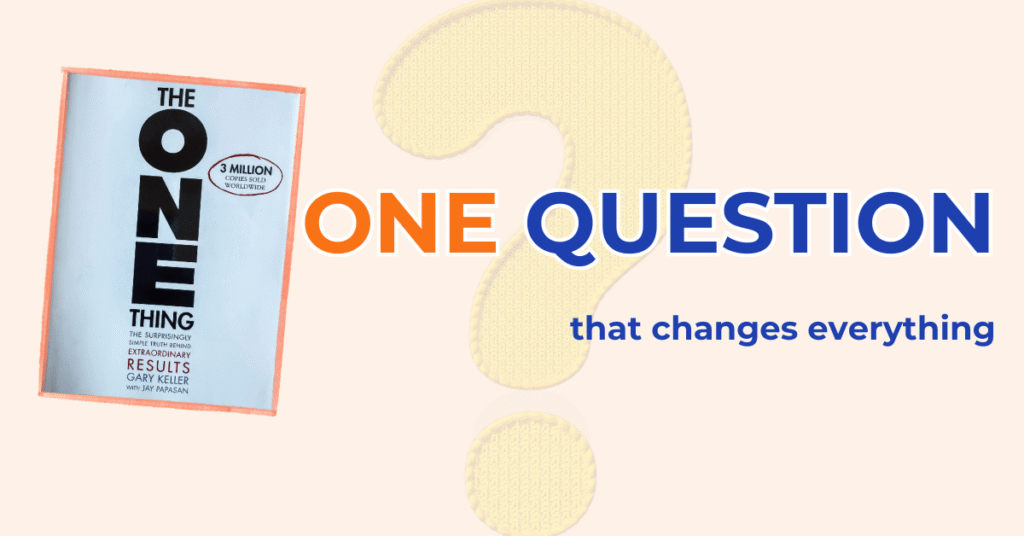
Gary Keller (founder and Executive Chairman of Keller Williams) and Jay Papasan’s book, The ONE Thing, makes one central argument:
Extraordinary results are directly determined by how narrow you can make your focus.
The core tool is the Focusing Question:
What’s the ONE Thing I can do such that by doing it everything else will be easier or unnecessary?
The book is divided into three parts:
In Part 1: The Lies, Keller debunks prevalent productivity beliefs such as “everything matters equally,” “multitasking works,” “achievement requires constant discipline,” “willpower is always on will-call,” “big is bad,” and the idea that a perfectly balanced life is attainable.
In Part 2: The Truth, he introduces the Focusing Question, the fundamental instrument underlying remarkable outcomes. He explains how to make your ONE Thing part of your daily routine and how to use what he refers to as the benchmarking and trending approach to find a strong answer to that question.
In Part 3: Extraordinary Results, Keller moves into execution. He covers purpose and priority setting, time blocking, the Goal Setting to the Now framework, which breaks down large objectives into manageable chunks, the three commitments required for great results, and the four productivity thieves that can quietly derail progress.
The book’s central thesis is straightforward yet audacious: you will outperform the version of yourself that is attempting to manage ten priorities at once if you discover your ONE Thing in each major life sector (spiritual life, health, relationships, career, and finances) and consistently set aside time to work on it.
What Makes This Book Stand Out (And Where It Falls Short)
What Works
The Focusing Question is genuinely powerful
What clicked for me wasn’t just the question itself, but realizing how badly I’d been asking the wrong one.
I used to ask:
“What are all the things I should be doing?”
Keller forces a shift toward:
“What’s the ONE Thing that makes everything else easier or unnecessary?”
The shift from plural to singular acts like a powerful noise filter.
Unlike vague advice to “prioritize better,” the Focusing Question is concrete, and you can ask it at different time scales:
- What’s my ONE Thing right now?
- Today?
- This week?
- This year?
- In five years?
- Someday?
Each answer should simplify the level above it, creating a cascading structure of priorities.
The recursive breakdown connects vision to action
Keller’s Goal Setting to the Now approach begins with a broad, abstract goal and works backward to a concrete action you can perform right now.
It allows you to line up your dominoes and choose which one, if it falls, will set off the next.
This makes enormous goals appear more attainable because you can see the actual path from where you are now to where you want to go.
Keller addresses the “but real life is messy” objection
Many reviewers say the book is unrealistic because it tells you to ignore everything except your ONE Thing.
However, if you read carefully, Keller actually introduces several frameworks for handling competing priorities.
- The glass vs. rubber ball metaphor: Work is like a rubber ball. It bounces back if you drop it. Family, health, friendships, and integrity, on the other hand, are all fragile. If you drop them, they shatter. When conflicts arise, protect the glass balls.
- The priority hierarchy: Keller explicitly prioritizes spiritual life, physical health, personal life, and key relationships over job and business. Work doesn’t come first. Instead, it is built on the basis of the others.
- Counterbalancing: You can go out of balance temporarily (for brief periods in your personal life, for longer in your professional life), but you must return before the damage is permanent. As Keller writes:
Never go so far that you can’t find your way back or stay so long that there is nothing waiting for you when you return.
- The negotiation tactic: When you can’t say no, Keller suggests negotiating: “If I have this done by [later time], would that work?” If that doesn’t work, you drop your ONE Thing but immediately reschedule it.
“Think big, go small” allows you to be ambitious without being paralyzed
Most people underestimate their long-term potential while overestimating their daily productivity.
Keller flips that. He inspires us to set extraordinary long-term goals and achieve them through small, focused daily efforts.
You don’t have to take every action necessary to achieve your ambitious objective all at once.
What matters is identifying your next domino, which is the ONE Thing you can do right now that moves you meaningfully closer to your long-term goal. Then you repeat the process.
Where It Falls Short
Purpose-finding is underdeveloped
The chapter on purpose basically says, “Ask yourself what would mean the most to you and the world,” and “Notice what gets you up in the morning.” Then “Pick a direction and start. You’ll get clarity through action.”
While this advice is reasonable, readers who feel completely lost and have no idea what energizes them may need more structured guidance before committing to a direction.
The framework assumes more schedule autonomy than many people have
The time-blocking strategies (protect your morning for your ONE Thing, be a maker before noon) work beautifully if you have control over your schedule.
However, what if your days are filled with meetings over which you have little control or urgent requests that cannot be deferred?
Although Keller provides negotiation tactics, implementing this framework in rigid, hierarchical, or highly reactive work environments may be more difficult than the book acknowledges.
The research method stays conceptual
Benchmarking and trending as a method for finding great answers to the Focusing Question is a smart idea: research what already works, then look for what’s emerging. It’s a useful lens, but it remains conceptual. The book doesn’t fully address practical questions like:
- How much research is enough before acting?
- How to distinguish genuine trends from fads?
- How to evaluate the quality of what you’re finding?
Five Lessons You Can Apply (With AI Integration)
Transparency note: Some of the AI tools mentioned below are examples that can help implement the ideas from the book. At the time of writing, I do not have affiliate relationships with these tools. If that changes in the future, this article will be updated to disclose any affiliate links.
Use the Focusing Question as your daily filter
Every morning, ask yourself:
“Today, what’s the ONE Thing I can do for my ONE Thing such that by doing it everything else will be easier or unnecessary?”
This question eliminates decision fatigue. Instead of continually deciding what to work on, you establish your priority once and then execute.
AI tools like ChatGPT or Claude can act as thinking partners. For example:
- “Here are my five priorities today. Help me identify the ONE Thing that would have the biggest impact.”
- “Which task is most likely to create a domino effect?”
Sometimes a short conversation is enough to reveal what truly matters.
Protect your ONE Thing through time blocking
Once you’ve decided on your ONE Thing for the day, schedule it like a real appointment. Time blocking ensures that your most important work receives your full attention.
Keller suggests blocking your schedule in this order:
- Time off—protect your “glass balls” (health, relationships, recovery)
- Your ONE Thing—ideally a focused block of at least 4 hours
- Planning time—daily prep, weekly review, and annual reflection
If your ONE Thing gets bumped, reschedule it immediately. Don’t let it disappear.
The difference between people who progress and people who stall isn’t perfect schedules. It’s the habit of returning to what matters most.
Tools like Motion or Reclaim AI can automatically protect focus blocks and reschedule tasks when conflicts arise.
For teams, Clockwise helps reorganize calendars to create longer, uninterrupted work sessions.
Use Goal Setting to the Now
From a long-term vision to the action you should take right now, Keller’s framework operates in reverse.
Begin with your someday goal and ask:
5 years:
“Based on my someday goal, what’s the ONE Thing I can do in the next 5 years to reach it?”
This year:
“Based on my 5-year goal, what’s the ONE Thing I can do this year to be on track to achieve my 5-year goal, so that I’m on track to achieve my someday goal?”
Then continue the chain:
- This month
- This week
- Today
- Right now
Notion AI or ChatGPT can help you work backward through each time horizon after you enter your long-term objective. They can highlight missing steps, suggest milestones, or challenge unrealistic timelines.
If you wish to visualize your domino chain, tools like Miro or FigJam make it easy to map the sequence.
Use brain dumps to manage mental chaos
A brain dump is a useful method for clearing mental clutter if your mind is continuously producing chores, thoughts, and “what-ifs.”
Whenever a thought appears during focused work:
- Write it down quickly
- Set it aside
- Return to your ONE Thing
Later, review the list and decide what deserves attention. Some items will turn into future tasks. Others will naturally fall away.
AI tools can make this process easier.
For example, voice notes combined with a transcription tool like Whisper enable you to speak your thoughts quickly without interrupting your workflow.
Notion allows you to create a “Brain Dump” database with tags like work, personal, ideas, or urgent.
Get comfortable saying no
Focusing on your ONE Thing inevitably requires saying no to many good opportunities.
As Keller puts it:
In the end, the best way to succeed big is to go small. And when you go small, you say no—a lot.
Although initially uncomfortable, this is necessary. Every “yes” to a new commitment competes with the work that actually moves your life forward.
You can have a ONE Thing in different areas of life, but you cannot have ten ONE Things within the same domain.
Clarity comes from choosing.
Note: AI tools evolve quickly. Features and pricing may change, so check the official websites for the most up-to-date information.
If you’d like to actually apply these ideas instead of just reading about them, I created a free ONE Thing Workbook based on the concepts from the book.
Inside the workbook, you’ll find exercises to help you:
- Identify your Someday Goal
- Work backward using Goal Setting to the Now
- Define your ONE Thing for this year, month, and week
- Build a simple daily focusing routine
You can download it here.
Prefer Watching Instead?
If you’d rather watch a structured breakdown of the book, I created a video explaining:
- The Focusing Question
- The Goal Setting to the Now framework
- The domino principle
- Practical ways to apply the ideas
Who Should Read This Book (And Who Shouldn’t)
Read this book if:
- You feel scattered across too many goals
- You start projects but rarely finish them
- You feel overwhelmed by competing priorities
- You want a framework that connects vision with daily action
Skip this book if:
- You already have extreme focus
- You want detailed tactical systems
- You need deep guidance on discovering your life purpose
This Book Pairs Well With…
If you found the ideas in The ONE Thing helpful, you may also enjoy:
- The 12 Week Year by Brian Moran
- Eat That Frog! by Brian Tracy
- Make Time by Jake Knapp and John Zeratsky
A Personal Reflection
Long after I finished reading The ONE Thing, I couldn’t shake this thought:
Most of us struggle because we divide our attention across too many goals at once, not because we lack ambition.
Modern life constantly pushes us toward more projects, opportunities, and commitments.
When everything feels important, there’s a risk that nothing gets the attention it needs to succeed.
Keller’s framework reminds us that progress frequently results from purposefully reducing our focus rather than broadening it.
It’s not difficult to comprehend this concept cognitively. The challenge is applying it consistently in a world that promotes busyness.
Final Thoughts: A Simple Idea That’s Harder Than It Looks
The ONE Thing’s core idea, to focus on one priority at a time, may appear almost too simple at first.
However, Keller excels in transforming that concept into a system.
🐝 BeeintheBook Rating for The ONE Thing: 8.5/10 – A solid, useful structure with actual constraints, but the fundamental idea is truly helpful for anyone overwhelmed with choices.
The Focusing Question forces clarity, Goal Setting to the Now connects long-term vision with everyday action, and time blocking protects the work that truly moves the needle.
None of these tools are groundbreaking on their own, but the way they reinforce one another gives the framework its strength.
However, the book isn’t perfect. The purpose-finding part is brief, and some of the strategies presume a level of schedule control that many people do not possess. Readers may need to modify the concepts for their own workplaces and life circumstances.
Nevertheless, the core message is one that many of us need to hear repeatedly:
Extraordinary results don’t come from doing more things.
They come from doing the right thing consistently.
As Keller writes at the end of his book:
To ignite your life you must focus on ONE Thing long enough for it to catch fire.
If you often feel busy but not truly progressing, The ONE Thing offers a useful lens for cutting through that noise.
Before you go, I’m curious:
What’s the ONE Thing you’re focusing on right now?
Let me know in the comments. Sometimes simply naming it is the first step toward making it real.